Website Design & Branding in IrelandSomething on yoursite is costingyou enquiries.
Which of these is closest to your situation?
Choose the closest one to see comparable projects, what that kind of work usually involves and roughly what it costs.
Website Design
A website that answers the questions your buyers actually have.
- Scope
- From a straight redesign to a site serving several different audiences
- Timeline
- Most take 2 months; 1 to 5 on the record
Scoped and priced per project
A short summary of where this would begin, for the people who have to agree to it.
Ten routes between seven engagements. The record confirms four.
This is how the work joins up, and which of those joins real projects have actually made. Choose an engagement to trace what it hands on to. A solid wire carries the number of projects that ran both ends; a hairline is how the work is sequenced, not something the record can show yet.
Stage 1 of 5
Stage 2 of 5
Stage 3 of 5
Stage 4 of 5
Stage 5 of 5
Search, Conversion & Growth
14 projects used it. Of the 13 with a published length, most take 2 months; 1 to 6 on the record. The other is continuing work rather than a fixed job.
The full engagement- Hands on to
- 1 project on the record
- Follows
- 9 projects on the record
How long it took, on 27 of 28 projects.
Not an estimate. This is the published duration of every project on this site, counted. Most land at 2 months, and the spread is the honest answer to “how long will mine take” — it depends on how much has to be written and how fast decisions get made.
Counted from the record - 27 of 28| Duration | Projects |
|---|---|
| 1 month | 6 |
| 2 months | 10 |
| 3 months | 4 |
| 4 months | 3 |
| 5 months | 1 |
| 6 months | 3 |
One project is not in that table: Go Wild Magazines, at 48 months. It is a continuing publishing relationship rather than a website build, and averaging it in would produce a figure no client would recognise. It is mentioned rather than dropped.
Real screens, straightened out of the photographs.
The clients’ own pages, de-skewed out of the original mockup shots rather than redrawn, at a size where you can read a layout decision instead of admiring a laptop on a slab. Two, not eight: nobody deciding whether to make contact reads eight case studies.
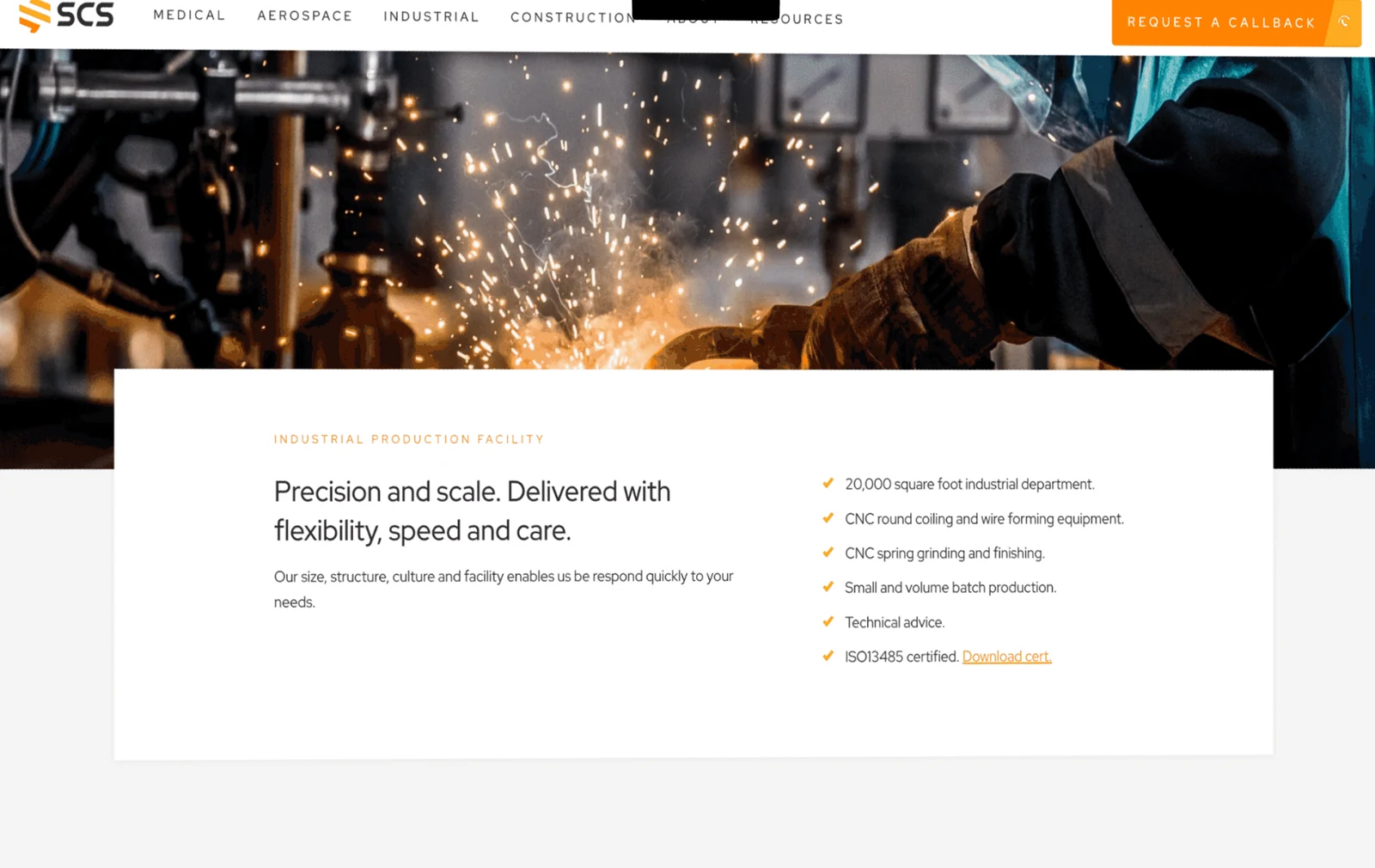
- Project
- Shannon Coil Springs
- Sector
- Industrial Manufacturing
- Year
- 2026
- Duration
- 6 months
- Capability, stated in the buyer's own terms
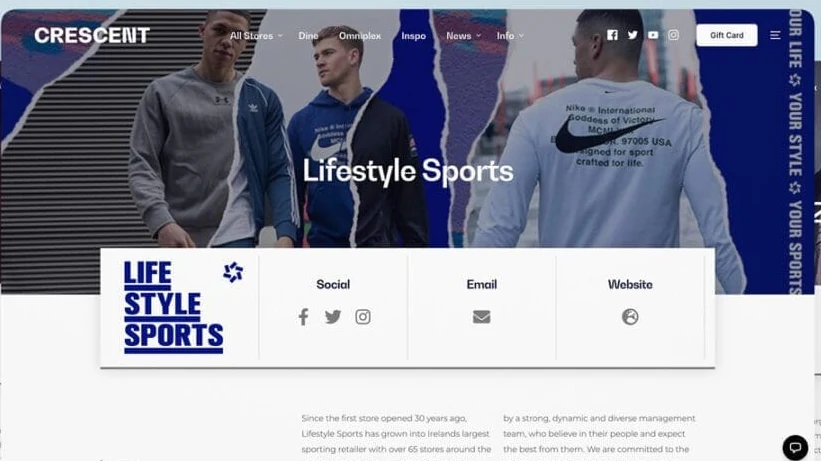
- Project
- Crescent Shopping Centre
- Sector
- Retail & Commerce
- Year
- 2023
- Duration
- 3 months
- One of ninety store pages in the directory
5 clients, describing what changed.
These are the only outcome claims on this site, and they are the clients’ sentences rather than mine — no before-and-after figure from any of these projects appears anywhere on this page. Square brackets mark one substitution: the studio’s other trading name, and the pronouns that follow from it. Same studio, same person.
Counted from the record - 5 of 11“We have been working with [Dave Curtin] for the last number of years and couldn't recommend [him] enough. Dave worked with us on a new brand re-design... which has greatly boosted our website traffic, performance, and overall user experience. [His] reporting system is top class.”
“[Dave Curtin] translated our complex business model into a simple, elegant digital experience. The new brand helps establish the trust we need to operate in healthcare, and the website makes onboarding patients more efficient.”
“Working with Dave Curtin made the process of designing our website very smooth and enjoyable. Digital technology was not our strongest point and we had always put it on the long finger, but once we started the process with Dave the project ran smoothly and without delay. With baking and food, we are trying to portray the smell, texture, taste and memories our products create, and Dave captured that concept very well. Our website has brought customers into our bakery and given them an insight into our operations.”
“[Dave Curtin] has been our creative partner since day one. [He doesn't] just design our magazines; [he shapes] our voice. [His] strategic input was instrumental in us winning the 'Best in the World' award in China.”
“The difference in our online visibility has been night and day. [Dave Curtin] didn't just design a website; [he] gave us a tool that actually brings new faces through the door.”
The other 6 are about what he was like to work with
“Dave is an absolute pleasure to work with and we are absolutely delighted with the website delivered. Excellent advice and creative guidance along with fantastic communication and quick turnaround. I would highly recommend [Dave Curtin] for your upcoming site design.”
“We recently worked with Dave and his team for a full website re-design. The end result is fantastic: professional, clean, and exactly what we needed to move the business forward.”
“Dave created a beautiful, polished website for my practice with very little direction from me. He has a real instinct for design and a strong understanding of what prospective clients need to see and feel when they land on a therapist’s website. The end result is professional, inviting, and aligned with the tone and trust a mental health practice needs to communicate. Beyond the initial build, Dave has been proactive in keeping my online presence aligned with the evolving rules and expectations around promoting a mental health practice digitally. That attention to detail has given me genuine peace of mind and has allowed me to focus on patient care, knowing the website remains both compliant and effective. On a personal level, I have also come to value Dave as a friend. He is warm, reliable, and consistently professional, and working with him has been a real pleasure.”
“I had the best experience working with [Dave Curtin]. [He was] easy to communicate with and efficient with every adjustment I asked for on my website design. I totally recommend [him] to everyone looking for this kind of service.”
“[Dave Curtin] facilitated a full re-brand of the festival including logo and brochure design. We were delighted with the design from first draft to completed brochure. [He] was able to capture the essence of the festival and understood the key aspects that we were looking to achieve in our branding and design. We will continue to work with [Dave Curtin] for our design needs as [he offers] an on point service with prompt response.”
“We have partnered with [Dave Curtin] to create and promote multiple websites over the last number of years. We are consistently happy with the results and the service provided.”
All 11 are named, with their role and organisation, and each links to the project it came from. Nothing is anonymised.
Start a projectAn Irish studio
One person does the work. That person is Dave Curtin.
Every project is designed, built and answered for by one senior designer, trading since 2010. You will not be handed to an account manager, because there is nobody to hand you to.
- Who you meet
- Dave Curtin
- Who does the work
- Dave Curtin
- Based in
- Limerick, Ireland

What happens after launch
Launch is not the end of the work, and it is not the start of a subscription either. Here is what happens by default, where the fork is, and what you should get in writing — from me, or from anyone else you are considering.
- 01
Before handover: training
Whoever will publish on the site is trained while it is still being built, so the first real edit happens with someone watching rather than alone, three weeks later, with a manual.
- 02
The first few weeks: monitoring
Testing finds the faults you can predict. Real traffic finds the rest — the form that fails on one Android keyboard, the page nobody scrolls, the search term nobody put in the brief. Dave Curtin is the one watching. There is no handover to a support desk, because there is no support desk.
What it produces is a document: what the first weeks showed, what is worth doing about it, and in what order. Written, not a call — something you can forward to whoever holds the budget.
- 03
Then the fork
Stopping here is a normal outcome, not a failed one. You have a site, a team trained to run it, and a written view of what to do next. If you do that work yourselves, that is a good result and the one most clients should expect.
Steady improvement, without a rebuild.
If a cycle stops being worth the money, we stop.
What a cycle contains
- A review of the site and its analytics
- An ordered list of what to fix
- A first round of changes, fixed in scope
- Usability and content fixes
- Speed and accessibility fixes
- A review every quarter
- Cycle length
- 4 to 8 weeks
- Exit
- You can stop at the end of any cycle
- When it is not the answer
- Where the foundation is sound, steady improvement achieves more for less. Where it is not, I will say so.
Four things to get in writing
These are not published here yet, and a number invented for a website is worth nothing anyway. Ask for them in writing before you sign — from me, and from whoever else you are talking to.
- How fast someone repliesand during which hours
- How long after launch a fault is fixed at no chargeand what counts as a fault rather than a change
- Where the site is hostedwhose account it is in, and who holds the keys
- How your team is trainedhow many people, and whether it is recorded
Questions people ask before they get in touch.
If the answer you need is not here, describe the situation and you will get a written reply rather than a brochure.
Ask about your projectThe two-minute diagnostic gives an honest read on whether you need a project at all, and the estimator sizes it in weeks. Neither asks for your email.
Enough varies between projects that a single figure would be misleading, so we do not publish one. What drives it is the number of pages that need writing, whether the brand needs work before the site can be designed, whether content is migrating from an existing site, and how much you want to be able to change yourself afterwards. The estimator on this site sizes a project in weeks from those answers, and a firm number follows one conversation rather than a form.
Two months is the most common, and three in four run between one and three months — that is counted from the durations published on this site, not an estimate, and the table on the homepage shows the full spread. The variable is rarely design time. It is how quickly decisions get made on your side and how much content already exists. A project where the copy has to be written from scratch takes longer than one where it needs editing, and that is worth knowing before you set a launch date.
Often just the website, and it is worth resisting the upsell. A rebrand is warranted when the identity actively contradicts what the company now does or who it now sells to. If the logo is simply dated but not wrong, a website that is clear and current usually solves the problem you actually have. The diagnostic on this site is built to tell the two situations apart.
Dave Curtin, from the first conversation to launch. There is no account manager between you and the person designing, and no handover to a junior team once the project is signed. That is the main practical difference between a one-person studio and an agency, and it cuts both ways: you get direct access and continuity, and the studio takes on fewer projects at a time.
Yes, and your team is trained before handover rather than sent a PDF afterwards. What you can change is agreed during the build, because that decision shapes how the site is built. A site where every page is freely editable is a different piece of work from one where the structure is fixed and the content is not.